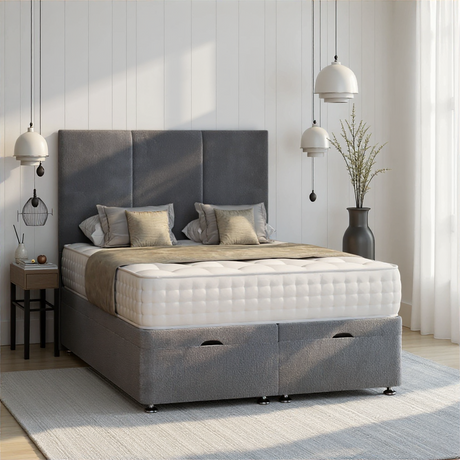
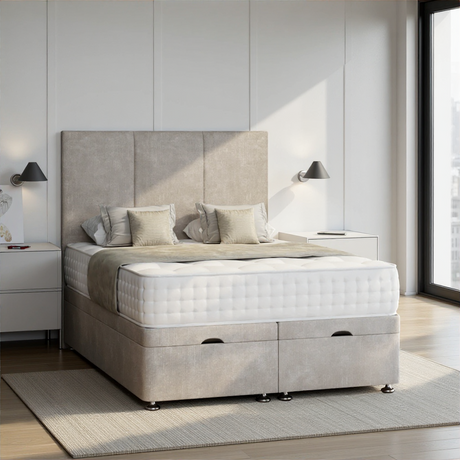
Somewhere in your house right now there is a pile that has no home. Two summer duvets, a suitcase that has not been emptied, the fan you will need again next July, a bag of clothes that fit somebody last year. Late August does this. The garden stuff comes in, the winter bedding needs to come out, and the airing cupboard gave up years ago.
This is usually the point at which somebody looks at an ottoman bed and asks the obvious question. How much will it actually hold? Not the marketing answer. The real one, in things you own.
It is a fair question, because ottoman storage is genuinely large, and the numbers involved sound made up until you see the space open.
Where the Storage Actually Sits
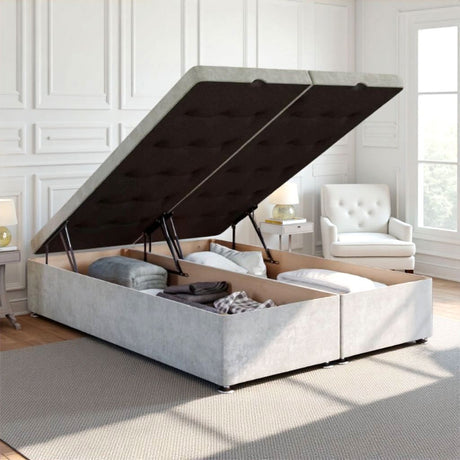
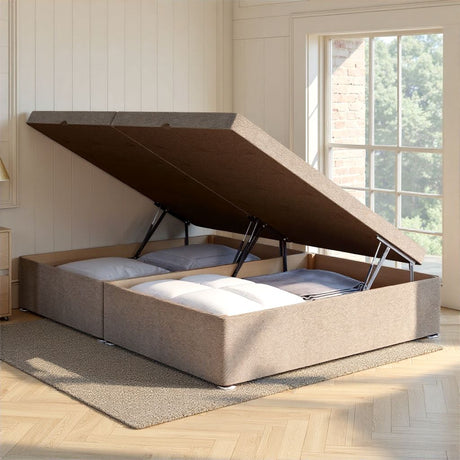
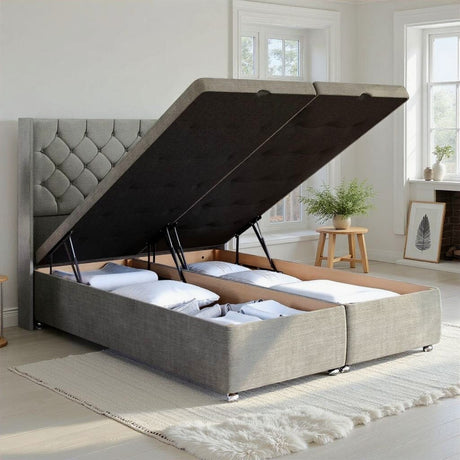
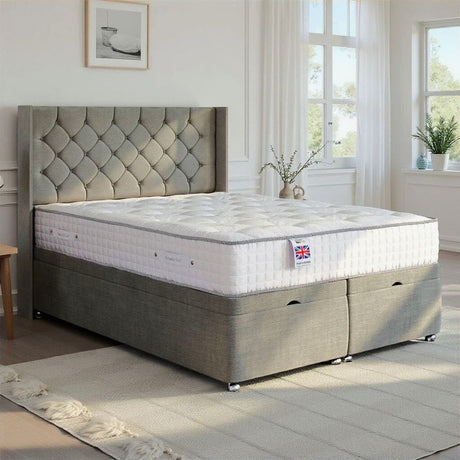
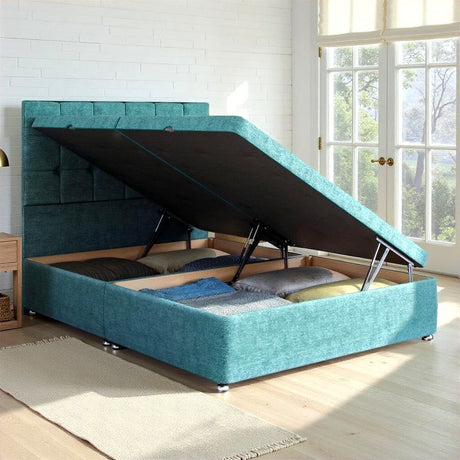
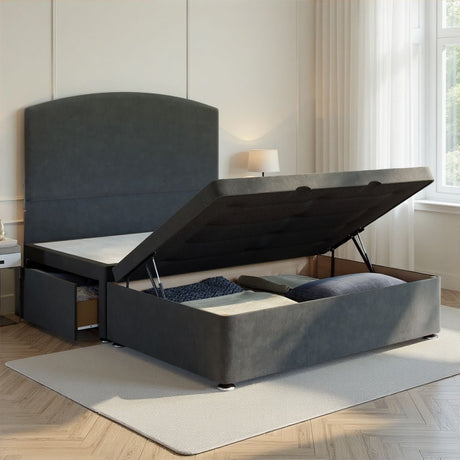
An ottoman bed is not a divan with drawers in the side. The entire mattress platform lifts on gas struts, and underneath it is one single open cavity running the full footprint of the bed.
That difference is the whole story. A drawer divan gives you two or four boxes with fixed sides, and you can only ever put in what fits through the drawer opening. An ottoman gives you the whole floor area of the bed, top-loaded, with nothing in the way. You can put a suitcase in flat. You can lay a rolled rug across it. Nothing has to be squeezed past a runner.
The cavity is bounded by the base sides and the platform above it, so the usable volume comes down to three measurements: the length of the bed, the width of the bed, and how deep the base is inside.
Ottoman Storage Capacity by Bed Size
Most ottoman bases give somewhere around 25 to 30cm of clear internal depth. Multiply that by the footprint and you get figures that surprise people. These are approximate usable capacities, allowing for the frame rails and the space the mechanism itself takes up.
Single, 3ft, 90 x 190cm
Roughly 380 to 450 litres. That is around four large suitcases laid flat, or a full set of winter bedding for the whole house with room left over. In a child's room it will swallow every out-of-season item of clothing they own.
Small Double, 4ft, 120 x 190cm
Roughly 500 to 570 litres. Enough for two spare duvets, a set of pillows, four or five storage bags of clothing and the suitcases on top of them.
Double, 4ft6, 135 x 190cm
Roughly 570 to 650 litres. To put that in something you can picture, it is comparable to a large double wardrobe laid on its back, or six to eight big suitcases. This is the size most people are asking about, and it is the one that usually empties the landing.
King Size, 5ft, 150 x 200cm
Roughly 670 to 750 litres. At this size you stop thinking in bags and start thinking in categories. Bedding down one end, luggage down the other, seasonal clothing across the middle.
Super King, 6ft, 180 x 200cm
Roughly 800 to 900 litres. It is more storage than most spare rooms contain in furniture, sitting under a bed that takes up no additional floor at all.
Why the Advertised Figure Is Not Always the Usable One
Capacity claims vary between retailers and it is worth knowing why, because it is not always the bed that is different.
Some figures are calculated on the outside dimensions of the base rather than the inside. Some ignore the frame rails that run around the edge, which take a few centimetres off the width and length you can actually use. Some quote the depth at the deepest point rather than the depth you can fill without fouling the platform when it comes back down.
If you want the honest number for a bed you are looking at, ask for the internal cavity dimensions rather than the litre figure, then work it out yourself. Length in metres, times width in metres, times depth in metres, gives you cubic metres. Multiply by 1000 and you have litres. A cavity of 1.30 x 1.85 x 0.26 comes out at 625 litres, and now you know where the number came from.
One more thing that eats capacity, and it is the one people forget. A very deep mattress does not reduce the cavity, but it does add weight to the lift. Gas struts are rated for a range, so if you are pairing a heavy pocket sprung mattress with an ottoman, check the strut rating rather than assuming.
Side Lift or End Lift, and What It Changes
Both give you the same cavity underneath. What changes is how you get into it and how much room you need around the bed.
An end lift opens from the foot of the bed and needs clear floor at that end. It suits a bed with one long side against a wall, which is most small rooms.
A side lift opens from the long edge and needs clear floor beside it. It gives you a wider opening and better reach into the middle of the cavity, so if the bed sits with both sides accessible it is often the easier one to live with day to day.
Measure the clearance before you choose. An ottoman that cannot fully open is an ottoman you will stop using by October.
What Actually Belongs Down There
The cavity is dry, dark and enclosed, which makes it very good for some things and poor for others.
Good candidates are seasonal bedding, spare pillows, luggage, out-of-season clothing in breathable bags, camping and beach kit, and anything bulky that you touch two or three times a year. Bedding in particular does well because it compresses and the space is deep enough to take it without cramming.
Keep out anything damp, anything that needs air, and anything you need daily. A slightly damp tent packed away in September will not thank you in May. Vacuum bags are useful for volume but do not seal moisture in with the contents, so make sure things go in properly dry.
Weight is worth a thought too. Spread heavy items across the base rather than piling them at one end, so the platform lifts evenly and the struts are not fighting an uneven load.
Built on a Solid Platform
Every ottoman base we make uses a solid platform top. The mattress sits on a continuous supportive surface with even pressure across the whole area, which is why a pocket sprung or memory foam mattress performs consistently on it rather than dipping where it is worked hardest.
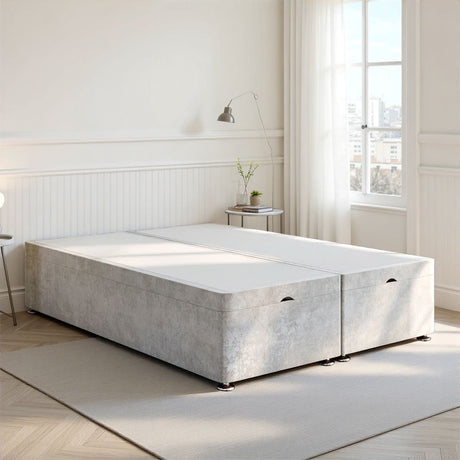
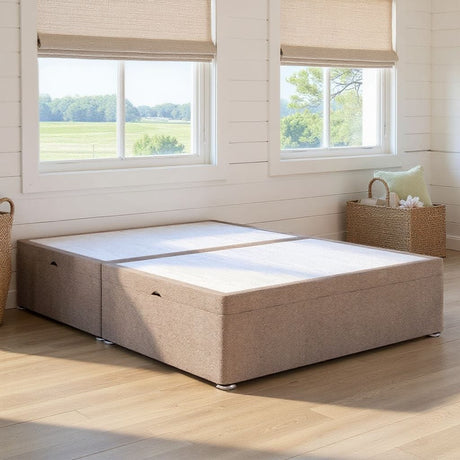
The upholstery is your choice across the full fabric range. Lino Stone and Naples Silver keep a small room light, Plush Charcoal and Chenille Navy give a deeper, more finished look, and Wool Clay sits somewhere warm in the middle. Our beds are endorsed by medical professionals, so the support underneath is doing a proper job while the storage does its own.
The Short Answer
A double ottoman bed holds somewhere around 570 to 650 litres, which is roughly a double wardrobe's worth of space, and it does it without taking a single extra centimetre of floor. Bigger sizes go up from there.
If the landing pile has been growing since June, that is the number that solves it. Have a look through the ottoman beds and check the internal dimensions against what you actually need to put away.
Every bed arrives with Complimentary Two-Man Delivery, brought into the room you want it in, so nobody is wrestling a base up the stairs on their own. Assembly is available as a delivery upgrade if you would rather not do it yourself. Get it in before the winter bedding comes out and the timing works itself out.